Qwen3.8-Omni-Flash turns a 1M-token video prompt into an agent workflow — but it only returns text
Qwen3.8-Omni-Flash is Alibaba's API-only native multimodal model for text, image, audio and video input. It pairs a 1M-token context window with OpenAI-compatible access, Qwen-MM-Plugins and Qwen-Live Harness.
Qwen launched Qwen3.8-Omni-Flash on September 18, 2026. It is a hosted native multimodal model that accepts text, images, audio, and video in one request. (Source: Qwen official announcement, 2026-09-18)
Key facts:
- The API model ID is
qwen3.8-omni-flash. - Its context window is 1 million tokens.
- It accepts text, image, audio, and video input.
- It returns text only; it is not a speech or video-generation endpoint.
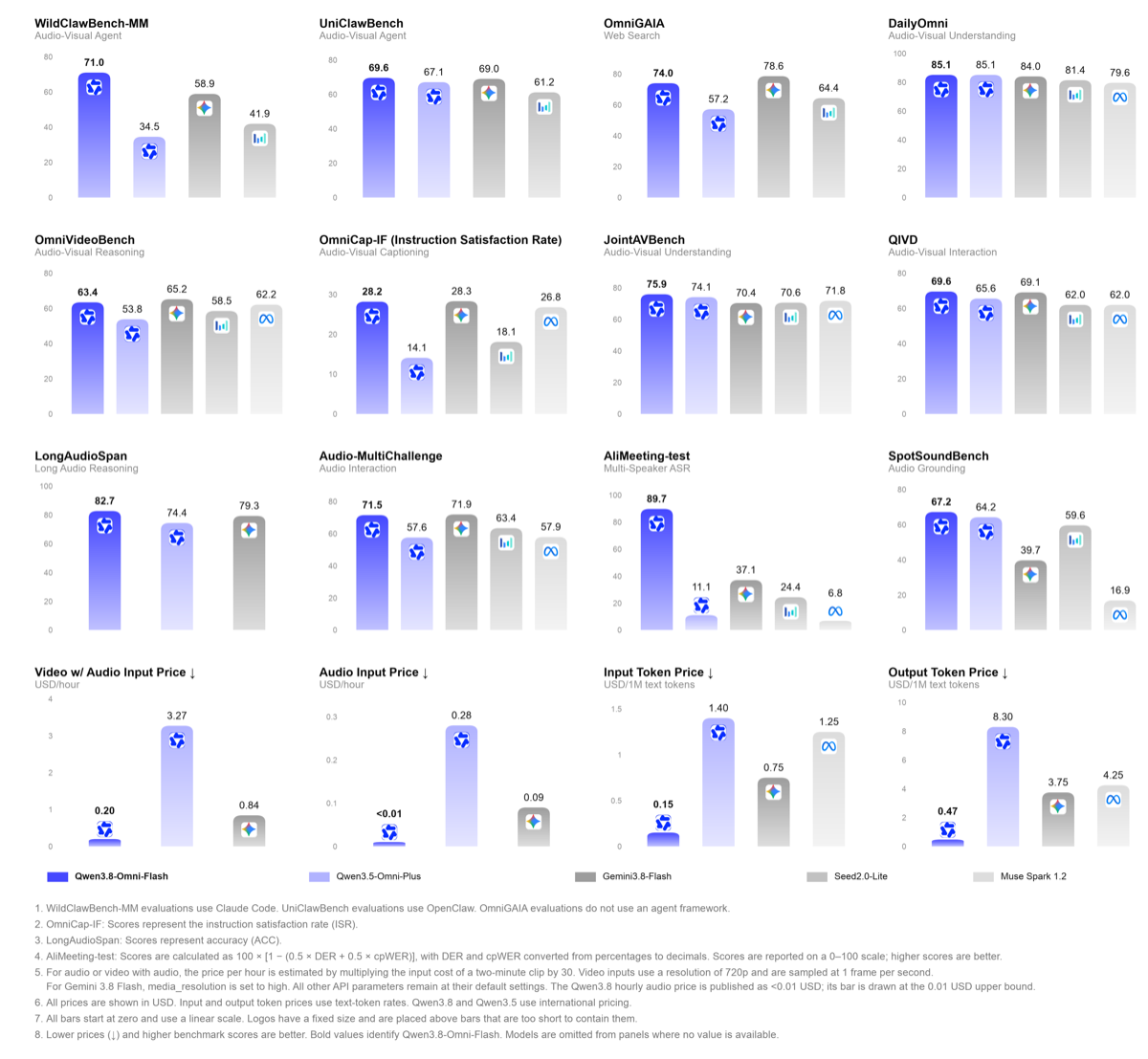
- List price is $0.15 per million input tokens and $0.47 per million output tokens.
- The model supports the DashScope and OpenAI-compatible protocols.
The useful change for builders is the input boundary
The release is not an open-weight checkpoint for llama-server, Ollama, or a local Qwen install. Alibaba lists it as a QwenCloud API model built on the Qwen3.8-Flash-Next architecture. That makes it a fit when an agent already has a hosted-model boundary and needs to inspect a recording, screenshot sequence, meeting video, or mixed media without first stitching together separate ASR, vision, and text calls. (Source: QwenCloud model page, accessed 2026-09-20)
The important caveat is output. The model page lists only text output. A workflow can ask it to find the relevant segment in a video, produce a structured edit plan, or extract action items, but it still needs separate tools to render a clip, synthesize speech, send a task, or change a file. “Omni” here means unified understanding on the way in, not a universal media generator on the way out.
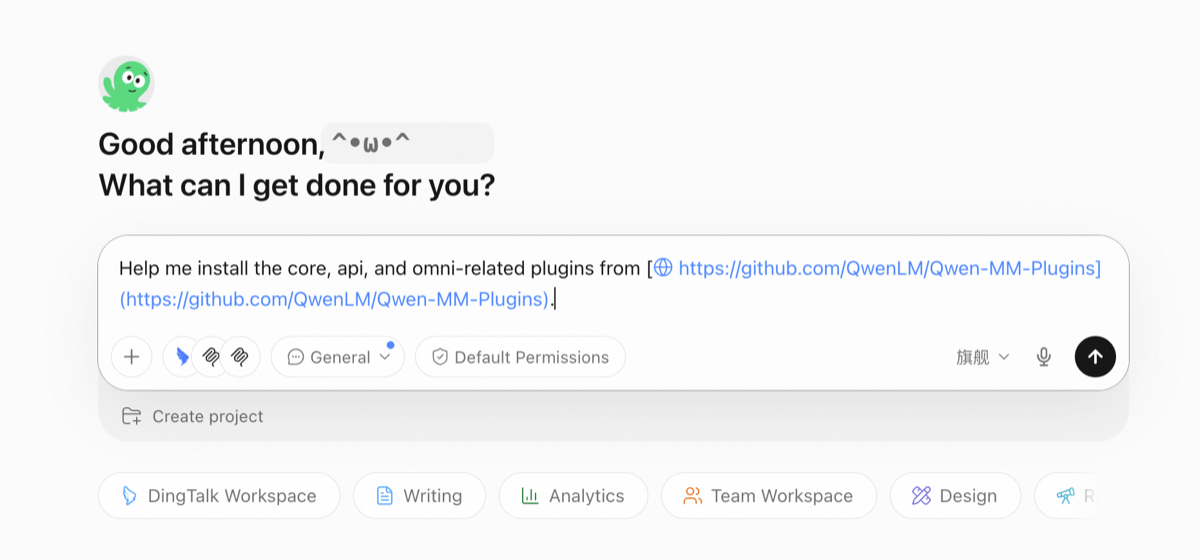
Alibaba says the model can use function calling, structured outputs, cache context, batches, and web search. It also publishes Qwen-MM-Plugins for agent frameworks and an open-source Qwen-Live Harness for continuous real-time multimodal interaction. The practical integration is therefore: keep your agent’s existing tool executor, replace its media-understanding call with qwen3.8-omni-flash, and require a schema for the resulting plan before a downstream tool acts on it. (Source: QwenCloud model page, accessed 2026-09-20)
Do not read the benchmark headline as a local-model recommendation
Alibaba reports more than a 25% average gain over Qwen3.5-Omni-Plus across 29 evaluations. It also reports a 36.5-point gain on WildClawBench-MM and a 22.3-point gain on AgenticVBench. Those are useful release signals, but they are Alibaba’s measurements and benchmark coverage is not the same as reliability in your media pipeline. (Source: Qwen official announcement, 2026-09-18)
The sharper cost claim needs the same caution. Alibaba says its estimated hourly audio-input price is over 98% lower and audio-visual input price over 93% lower than the comparison baseline. Its footnote assumes 30 times the input cost of two minutes of material and 720p at one frame per second for audio-video. That is not a quote for every upload or a guarantee of end-to-end agent cost.
If your project is text-first and local, start with our Qwen3.6 local coding guide instead. If Qwen is controlling tools around a local endpoint, pair it with the llama-server built-in tools safety guide so a media-derived plan cannot silently become unrestricted shell access. For the earlier hosted flagship’s deployment trade-offs, see Qwen3.8-Max’s official numbers.