Qwen3.8-2.4T-A95B Download Sizes: 397GB GGUF & FP8
Qwen3.8-2.4T-A95B needs 4,893GB in BF16 or 397GB at 1-bit GGUF. Compare FP8, quant sizes, context limits and its commercial license.
Alibaba published the Qwen3.8-2.4T-A95B weights on Hugging Face on August 12, 2026. It is the first time a Qwen-Max-class model has been released openly. (Source: Qwen model card; the repo’s last-modified timestamp is 2026-08-12T10:24Z and the r/LocalLLaMA release thread went up the same day.)
Key facts:
- The model is 2.4 trillion parameters with 95 billion active per token. The safetensors index reports 2,446,182,725,504 parameters, all BF16.
- The BF16 checkpoint is 4,893 GB across 140 shards. Alibaba also published an official FP8 build, and at the time of writing the FP8 repo has more downloads (3,851) than the BF16 one (978).
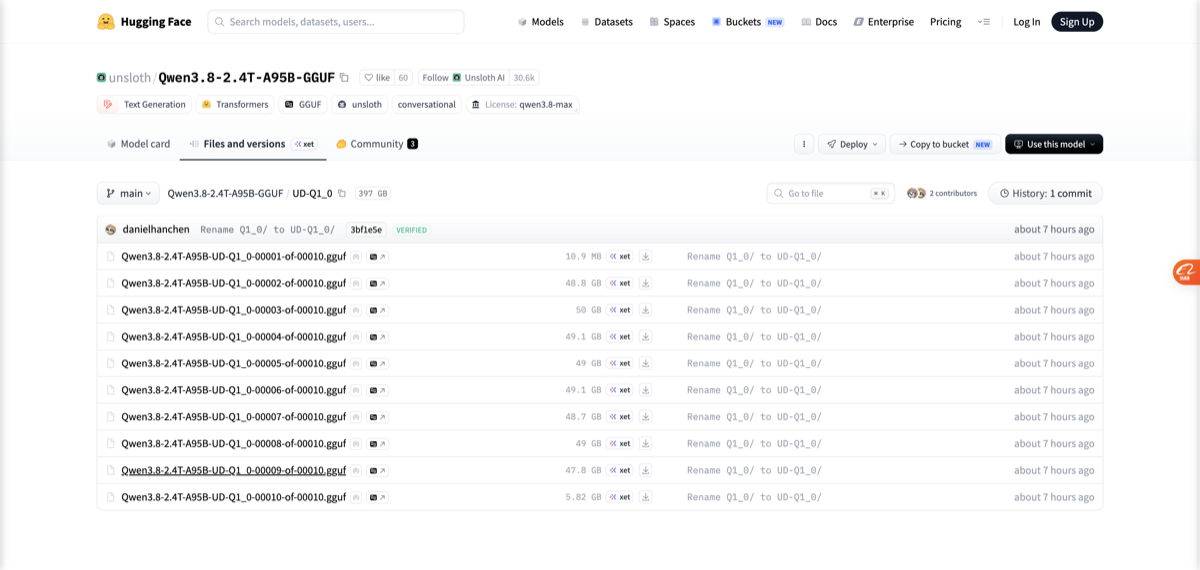
- The smallest community quant is 397 GB. Unsloth’s dynamic
UD-Q1_0GGUF is 397 GB over 10 shards; itsUD-IQ1_Sis 508 GB and itsQ8_0is 2,600 GB. - Native context is 262,144 tokens, extensible to 1,010,000.
- The open weights are text-only and thinking cannot be disabled. Every response begins with a
<think>…</think>block. The hosted Qwen3.8-Max keeps vision input, a non-thinking mode, 1M context by default and built-in tools. - The license is
qwen3.8-max, not Apache-2.0. - Qwen3.8-27B is now the practical local alternative. Alibaba released the smaller dense checkpoint on August 13; its community GGUF builds start at 9.0 GB, with Q4_K_M at 17.1 GB, instead of 397 GB for this model’s smallest 1-bit quant. See the Qwen3.8-27B open-weights guide.
What this means if you’re building with Qwen3.8
1. “Open weights” here means auditable and fine-tunable, not workstation-friendly. At 397 GB the cheapest quant needs a multi-GPU server or a very large unified-memory box, and that is a 1-bit quantization of a frontier model — expect quality loss nobody has measured yet. The practical read: this release changes who can host the model, not who can run it at home. For local hardware, start with Qwen3.8-27B or the tested Qwen3.6 coding setup.
2. Read clause 2 of the license before you resell inference. The license text is MIT-shaped, but two conditions attach. If your product passes 100 million monthly active users or US$20 million monthly revenue, you must display the model name in your UI. And if you run a “Model as a Service” or an “AI Work Assistant” business whose revenue exceeds US$50 million over any twelve consecutive months, you need a separate license from Qwen before any commercial use. Internal use that does not expose the model to third parties is carved out. (Source: LICENSE)
3. Budget for forced reasoning tokens. The API-hosted Max lets you turn thinking off; the open checkpoint does not. Qwen’s own guidance is to allow 262,144 tokens for reasoning content and 131,072 for the final response, with temperature=1.0, top_p=0.95, top_k=20. If you priced a workload against the hosted non-thinking mode, that number does not carry over.
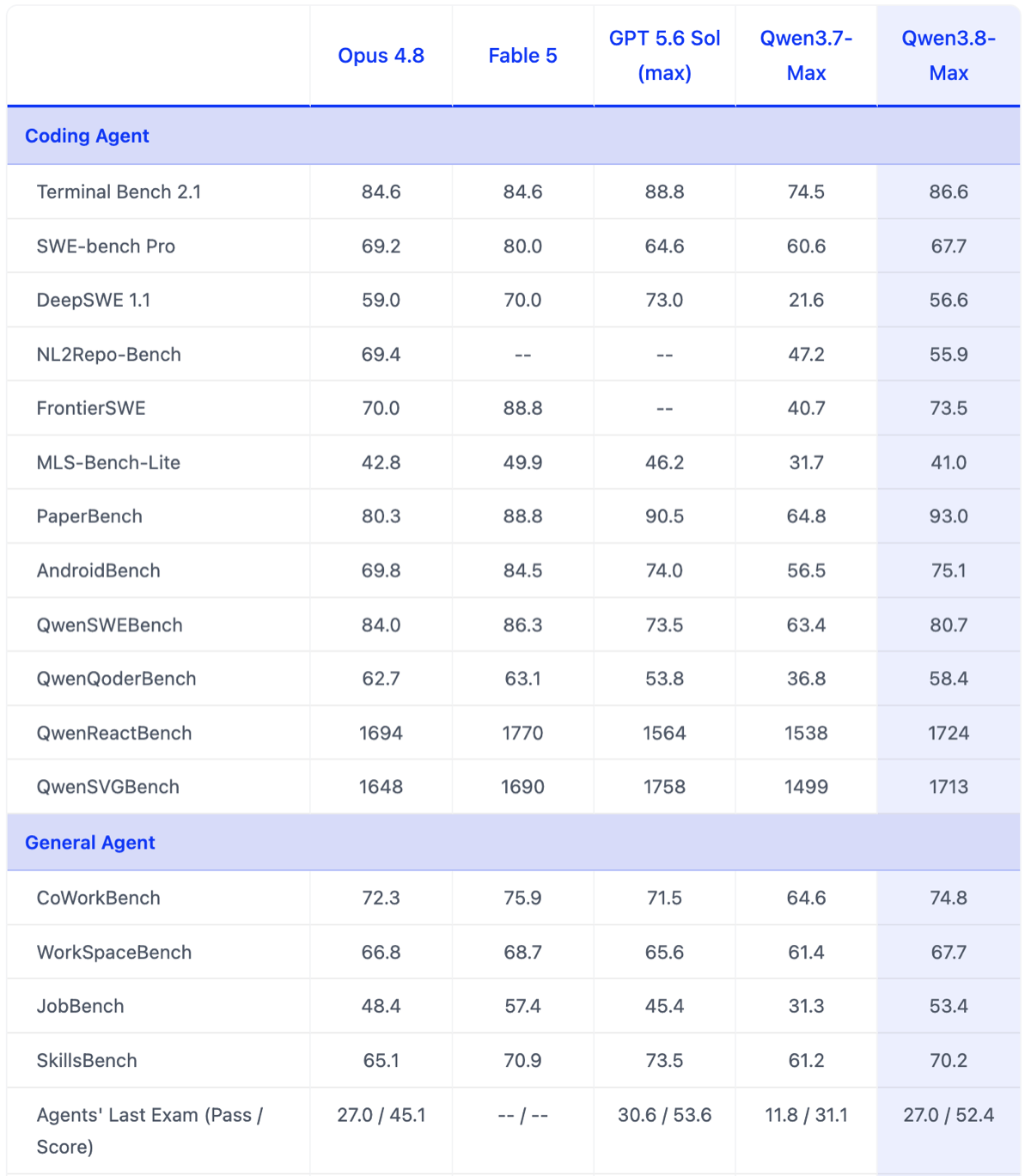
4. The independent number is lower than the card. Artificial Analysis places Qwen3.8 Max at 58 on its Intelligence Index — below Claude Opus 5 (63), Claude Fable 5 (62), GPT-5.6 Sol (61) and Grok 4.6 (61), and above Muse Spark 1.2 (57). That is a strong open-weight result, not a frontier-topping one. (Source: Artificial Analysis, 2026-08-12)
5. The main thing you gained is optionality. Ten days ago we noted that open weights were still a promise. They are not anymore. Even if you keep calling the hosted API, a published checkpoint means a third party can serve it, you can pin a version, and a pricing change or deprecation is no longer a hard dependency.
Sources: Qwen3.8-2.4T-A95B model card · Qwen3.8-Max license · unsloth GGUF quants · Qwen official blog · r/LocalLLaMA release thread
Related: How to access Qwen3.8-Max Preview · Qwen3.8-Max official numbers · Qwen3.7-Max
Source: Qwen (Hugging Face model card)