GPT-5.6 Sol Ultra Posts a Proof of the Cycle Double Cover Conjecture — What Builders Should Actually Take From It
OpenAI published a PDF, authored 'entirely due to GPT-5.6 Sol Ultra,' claiming a proof of the 50-year-old Cycle Double Cover Conjecture. It is not peer-reviewed yet. The real builder takeaway isn't the math — it's the ultra reasoning tier and the 64-subagent run behind it.
Key facts: On July 10, 2026, OpenAI published a PDF titled A Proof of the Cycle Double Cover Conjecture, with the author line reading simply “OpenAI.” The paper’s “Statement of AI use” says the proof is entirely due to GPT-5.6 Sol Ultra, with the writeup done in Codex. The conjecture is roughly 50 years old. OpenAI’s announcement says the run used 64 subagents and finished in under an hour. The proof is machine-checked but not peer-reviewed — treat it as a claim, not a settled result.
What was published
The document states one theorem (Theorem 1.1): every finite bridgeless undirected graph has a cycle double cover — a collection of cycles in which every edge appears in exactly two of them. The abstract credits the conjecture to Tutte, Itai and Rodeh, Szekeres, and Seymour, dating it to the 1970s. (Source: OpenAI proof PDF, July 10, 2026.)
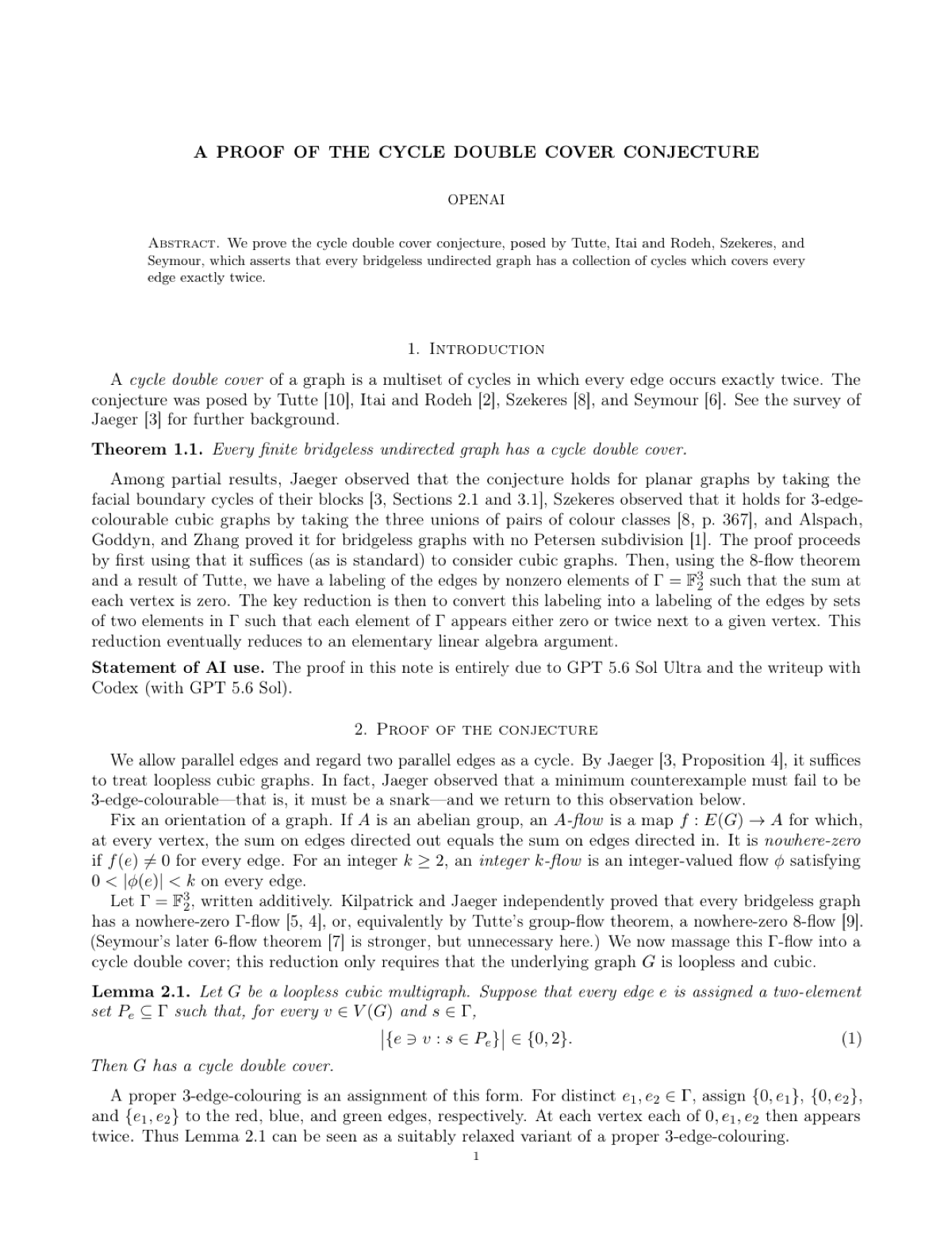 First page of the official PDF. The “Statement of AI use” reads: “The proof in this note is entirely due to GPT-5.6 Sol Ultra and the writeup with Codex (with GPT-5.6 Sol).” (Source: OpenAI proof PDF)
The argument reduces the problem to cubic graphs, invokes a nowhere-zero 8-flow (labeling edges by nonzero elements of Γ = 𝔽₂³ so the sum at each vertex is zero), then converts that into a two-element-set labeling that forces each edge into exactly two cycles via an elementary linear-algebra step. (Source: OpenAI proof PDF, §1–2.)
The honest caveat
A machine-verified proof is not a peer-reviewed proof. As of publication, mathematicians on Hacker News and Reddit were still checking whether the argument holds; no external verification had been confirmed. (Source: Hacker News thread; CryptoBriefing.) We are reporting the claim and the artifact, not endorsing the result.
What this means if you’re building with GPT-5.6
Skip the “AI solved math” headline. Two concrete, shippable things sit underneath it:
- The ultra reasoning tier is real and generally available. GPT-5.6 shipped a new
max/ultrareasoning-effort setting on July 9. Sol Ultra is that dial turned all the way up — the same knob you can set on your own API calls. See our guide on how to switch to GPT-5.6 for the exact model IDs and reasoning-effort parameters. - The win came from orchestration, not one giant prompt. OpenAI says the run fanned out to 64 subagents. That’s the same multi-agent pattern builders are using for reviews, migrations, and audits — parallel workers, each scoped narrowly, results synthesized. The lesson for your stack: hard problems respond to fan-out + verify, not a single longer context.
The prompt that produced the proof is also public (prompt PDF) — worth reading if you’re designing high-effort reasoning tasks of your own.
Sources
Source: OpenAI — official proof PDF